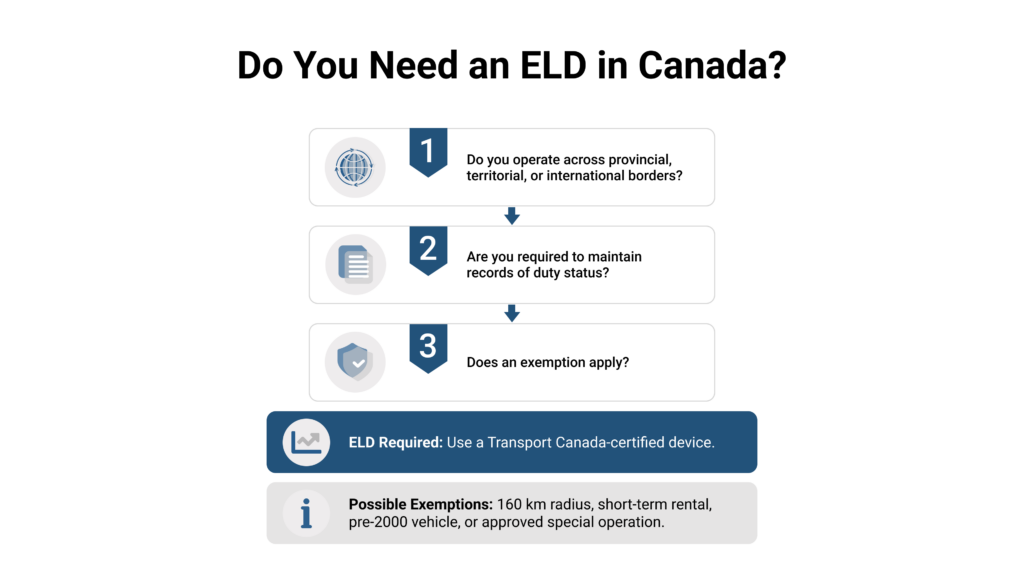
Canada’s ELD mandate affects most federally regulated commercial drivers who are required to maintain records of duty status. To stay compliant, fleets must use a Transport Canada-certified device, follow applicable Hours of Service rules, and ensure drivers can produce accurate records during inspections.
TitanGPS provides a Transport Canada-certified electronic logging device (ELD) built to meet the Canadian ELD Technical Standard, giving federally regulated carriers certified hours-of-service logging paired with GPS fleet tracking in one platform. Since Canada requires third-party certification rather than the US self-certification model, confirm any ELD you’re evaluating including TitanGPS appears on Transport Canada’s published certified-device list before purchase.
This guide explains who needs an ELD, which exemptions may apply, how certification works, what drivers must do when a device malfunctions, and what fleets should look for when choosing a compliant ELD for Canadian and cross-border operations.
TL; DR
- Most federally regulated commercial drivers who maintain records of duty status must use a Transport Canada-certified ELD.
- Canadian ELDs require third-party certification, which vendors can self-certify.
- Common exemptions include qualifying 160 km operations, short-term rentals, pre-2000 vehicles, and certain emergency or special-use operations.
- Drivers must know how to manage duty status, unidentified driving, malfunctions, paper logs, and roadside record transfers.
- The right ELD should support Canadian HOS rules, offline recording, roadside inspections, HOS alerts, GPS tracking, and DVIR workflows.
What Fleets Need to Know About the Mandate
Canada’s electronic logging device mandate requires most federally regulated commercial drivers who maintain records of duty status to use a certified ELD. The mandate is intended to improve Hours of Service accuracy, reduce log tampering, and help lower fatigue-related safety risks.
A compliant ELD must meet the Canadian ELD Technical Standard, pass independent third-party testing, appear as active on Transport Canada’s certified ELD list, and support roadside display and data transfer.
Federal requirements are enforced by provincial and territorial authorities. Fleets operating within one province must also confirm whether provincial ELD rules apply.
“Commercial motor vehicle drivers who cross provincial/territorial borders must use certified electronic logging devices.”
Source: Government of Ontario
Core ELD Requirements in Canada
Canada’s ELD requirements fall under the Commercial Vehicle Drivers Hours of Service Regulations. Whether a driver needs an ELD depends on the carrier’s operating authority, the vehicle, the route, and whether the driver must maintain a record of duty status.
Who Must Use an ELD?
An ELD is generally required for drivers working for federally regulated carriers, operating vehicles covered by federal HOS rules, and maintaining records of duty status. This typically includes carriers crossing provincial, territorial, or international borders.
Federal rules apply to trucks, tractors, trailers, or combinations over 4,500 kg, as well as buses designed for more than 10 people.
Drivers may qualify for the 160 km exemption when they return to the home terminal each day, receive the required off-duty time, and have their hours recorded by the carrier. If they leave the radius, they must enter the previous 14 days of HOS information.
Provincial rules vary. Ontario and British Columbia have ELD requirements, while Alberta does not currently require them for carriers operating only within the province and outside federal regulation.
What Is a Certified ELD?
A certified ELD is a hardware and software configuration independently tested by a certification body accredited by the Minister of Transport.
To qualify for use in Canada, the exact product, application, platform, ELD identifier, and certification number must appear as active on Transport Canada’s certified ELD list.
Technical Standard v1.3 Overview
“The Canadian Technical Standard for ELDs version 1.3…replaces the previously posted version 1.2.”
Source: Canadian Council of Motor Transport Administrators
The Canadian Council of Motor Transport Administrators published version 1.3 of the Canadian ELD Technical Standard on September 29, 2025. It replaced version 1.2.
The standard covers engine synchronization, automatic driving detection, GPS and location recording, engine hours, vehicle distance, driver accounts, unidentified driving, personal conveyance, yard movements, log certification, malfunction codes, roadside data transfer, and tamper prevention.
Transport Canada’s certified list may continue to show active devices certified under version 1.2 during the transition. Fleets should rely on the current status of the exact device rather than the version number alone.
ELD Certification Explained
Canada requires independent testing before an ELD can be used by regulated carriers. The vendor submits its hardware, software, and application configuration to an accredited certification body. Once the product passes testing, it receives a certification number and can be added to Transport Canada’s certified ELD list.
Third-Party Certification Bodies
Certification bodies must be accredited through the Standards Council of Canada and approved by Transport Canada.
Transport Canada’s current registry lists COMDriver Tech and FPInnovations. These organizations test ELD hardware, software, and mobile applications. They also review product changes and determine whether further testing is required.
Testing Criteria & Compliance Rules
Certification testing verifies that the ELD can synchronize with the vehicle, detect movement, and record driving time, distance, and location. It also checks driver account controls, unidentified driving, log edits, roadside data transfer, malfunction detection, and tamper protection.
Vendors must report material product changes to the certification body. Software, hardware, or application updates may require further review or retesting.
ELD Exemptions in Canada
An ELD exemption does not always remove the driver’s HOS or record-keeping obligations. Paper logs or supporting documents may still be required.
Short-Term Rentals
A commercial vehicle may qualify for the federal rental exemption when the agreement is 30 days or less and is not renewed or extended for the same vehicle. The driver must still follow applicable HOS limits and maintain the required records.
For example, a carrier renting a replacement truck for 12 days may use paper logs if the rental qualifies for the exemption.
Non-HOS Vehicles
A driver who is not required to maintain a record of duty status does not need an ELD for that operation. This may include drivers who meet every condition of the 160 km radius exemption.
Vehicles manufactured before model year 2000 are also exempt from the federal ELD requirement. However, drivers may still need to follow HOS limits, maintain paper logs, carry supporting documents, and produce records during an inspection. However, the exemption applies to the ELD requirement, not every HOS obligation.
Special Operations
Federal HOS rules exclude certain limited operations, including qualifying movements of primary farm, forest, sea, or lake products, certain empty return trips, emergency vehicles, and vehicles providing relief during a public welfare emergency.
These exclusions have specific conditions and should not be treated as broad agricultural or seasonal exemptions.
A vehicle may also operate without an ELD when the carrier has an applicable permit or an exemption under the Motor Vehicle Transport Act. Supporting documentation should remain available during the trip.
Pro Tip: Before dispatch, confirm the exact exemption, keep supporting documents in the vehicle, and make sure the driver knows which HOS and paper-log rules still apply.
Using an ELD: What Fleets Must Follow
A certified ELD must be configured and used correctly. Drivers need training, while carriers must review logs, unidentified movement, and malfunction events.
Duty Status Automation
A compliant ELD records driving status once the vehicle reaches the configured threshold, up to 8 km/h. After five minutes stationary, it prompts the driver to confirm the status. No response within one minute changes it to On-Duty Not Driving.
Automatically recorded driving time generally cannot be changed. Other edits must retain the original entry, include a reason, and be reviewed by the driver when proposed by the carrier.
Movement without a signed-in driver is recorded as unidentified driving and must be assigned or explained by the carrier.
Personal conveyance applies only when the vehicle is not being used for carrier business, is unloaded, has no trailer attached, travels no more than 75 km that day, and records beginning and ending odometer readings.
Malfunction Codes & Troubleshooting
An ELD must display a malfunction or diagnostic code when it cannot capture required information correctly.
When a malfunction occurs, the driver should:
- Notify the carrier after parking safely.
- Record the malfunction code, date, and time.
- Record when the carrier was notified.
- Use paper logs when the ELD cannot produce a compliant record.
- Retain supporting documents for reconstructed logs.
The carrier must generally repair or replace the device within 14 days. If a planned trip lasts longer, the repair must occur when the driver returns to the home terminal.
Loss of cellular service does not automatically mean the ELD has malfunctioned. A compliant system may continue recording locally and synchronize when connectivity returns.
Driver Responsibilities
Before driving, drivers should sign in, select the correct HOS cycle, confirm the vehicle and trailer, review prior logs, and resolve missing or unidentified driving records. They must certify their logs and know how to display or transfer them during an inspection.
Each vehicle must carry the ELD manual, inspection and malfunction instructions, and at least 15 days of blank paper logs. Drivers must also produce the current day’s record, the previous 14 days, trip documents, and any applicable permit.
Pro Tip: Include ELD sign-in, unidentified driving, roadside transfer, and malfunction procedures in regular driver training so issues are resolved before they become inspection violations.
Enforcement & Penalties
Provincial and territorial authorities enforce federal ELD and HOS requirements. Inspection processes are similar across Canada, but penalties vary by jurisdiction.
What Roadside Inspectors Check
During an inspection, a driver may need to provide the current day’s record, the previous 14 days of records, supporting documents, applicable permits, and an electronic transfer or display of the ELD data.
Inspectors may review the device’s certification status, the driver’s identity, HOS totals, unidentified driving, personal conveyance, log edits, malfunction events, and evidence of tampering. Drivers should be able to access and transfer the required records without calling the office.
Consequences of Non-Compliance
ELD and HOS violations may lead to warnings, fines, inspection delays, carrier-profile consequences, record corrections, driver detention, or out-of-service declarations.
An out-of-service declaration may be issued when a driver exceeds HOS limits, cannot produce required records, maintains multiple records for the same day, falsifies records, or tampers with the ELD.
Tampering includes disconnecting, blocking, disabling, or reprogramming the device so it no longer records accurately. Falsification or tampering may result in a 72-hour out-of-service declaration. The restriction can continue until the records are corrected and compliance is confirmed.
Simplify ELD Compliance with Titan GPS
Choosing a Transport Canada-certified ELD is only the first step. Fleets also need a system that supports Canadian HOS rules, works reliably offline, simplifies roadside inspections, and connects with the rest of their fleet operations.
Titan GPS ELD Logbook brings driver logs, HOS alerts, vehicle location, digital inspections, and supporting documents into one platform. Transport Canada currently lists the Titan Android and Titan iOS applications as active certified ELDs through Certified Tracking Solutions.
By connecting ELD compliance with GPS tracking and DVIR workflows, Titan GPS helps drivers manage daily logs more easily while giving fleet managers clearer visibility into records, inspections, and potential compliance issues.
Talk to a Titan GPS expert to find the right ELD solution for your fleet.