

Construction equipment is expensive, mobile, and often spread across multiple job sites. Yet many construction companies still rely on manual logs, phone calls, or end-of-day reports to understand where equipment is, how it is used, and whether it is available when needed.
That gap creates unnecessary costs. Equipment theft, unplanned downtime, excess idling, and poor utilization quietly drain budgets and delay projects. Most of these losses are avoidable when fleets have reliable GPS visibility across vehicles and assets.
GPS tracking for construction equipment gives operations teams a clear, live view of where assets are, how long they are used, and when attention is needed. It replaces guesswork with data and helps protect equipment, control costs, and keeps projects on schedule.
TL;DR
- GPS tracking reduces equipment losses by giving construction teams real-time visibility instead of relying on assumptions.
- Live location and usage data help managers assign equipment faster and avoid job site delays.
- Utilization insights lower costs by reducing unnecessary equipment rentals and purchases.
- Early movement alerts improve theft detection and increase the chances of asset recovery.
- Historical usage data supports better planning, maintenance scheduling, and long-term fleet decisions.
Why Do Construction Companies Need GPS Tracking Now?
Construction operations have changed. Job sites are more distributed. Timelines are tighter. Equipment values are higher. Theft and misuse continue to rise, especially at unattended or remote locations.
Many fleet managers face the same issues:
- Equipment sits idle while crews wait for machines they thought were available
- Assets move between sites without documentation
- Maintenance issues surface only after a breakdown
GPS tracking addresses these problems by making equipment activity visible in real time. Instead of reacting after delays or losses occur, teams can monitor usage, spot issues early, and respond faster.
For operations leaders, the value is simple. Better visibility leads to better decisions. Better decisions protect margins.
Understanding Construction Operations and Challenges
Every construction business operates differently, but challenges tend to follow common patterns.
Equipment is often shared across jobs. Operators rotate between sites. Vehicles and machines may sit unused for long stretches or run longer than planned. Without accurate tracking, it becomes difficult to answer basic questions:
- Which assets are currently in use
- Where idle equipment is parked
- How long machines run each day
- Whether equipment is being moved without approval
These gaps affect productivity, safety, and cost control. GPS tracking creates a single source of truth for equipment activity, regardless of job size or location.
Key Sectors and Their Fleet Management Needs
Different construction sectors experience these challenges in slightly different ways.
- Residential construction relies on short job cycles and frequent equipment movement. Visibility helps ensure the right tools arrive on time.
- Commercial construction involves higher value assets and longer project timelines, making theft prevention and utilization tracking critical.
- Industrial construction depends on specialized equipment where downtime can halt entire workflows.
- Infrastructure projects operate across large, remote areas where physical oversight is limited.
GPS tracking supports all of these environments by delivering consistent, location-based data that works across job sites.
Pro tip: Set up “start-of-shift” and “end-of-shift” GPS check-ins (utilization + after-hours movement alerts) so you can spot idle assets, unauthorized moves, and missing equipment before they turn into schedule delays or theft losses.
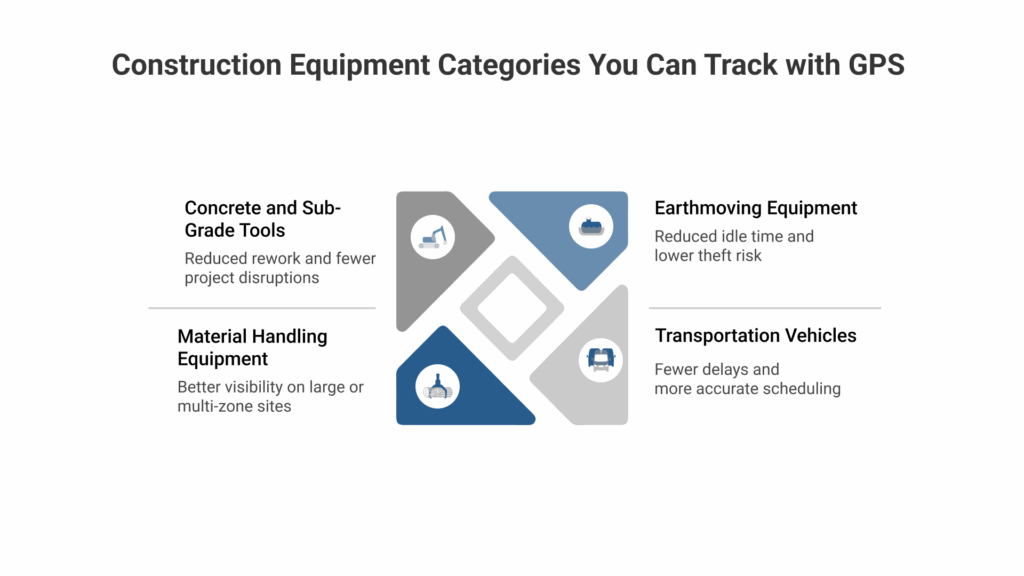
Construction Equipment Categories You Can Track
Not all construction assets face the same risks or usage patterns. Effective GPS tracking starts by understanding how different equipment types contribute to daily operations.
Earthmoving Equipment
Bulldozers, excavators, loaders, and graders represent some of the highest-value assets on a job site.
GPS tracking helps teams:
- Verify location during and after work hours
- Monitor run time to prevent overuse or neglect
- Identify underutilized machines that can be reassigned
This reduces idle time and optimizes asset utilization.
Transportation Vehicles
Dump trucks, service trucks, and flatbeds move materials and equipment between locations.
Tracking these vehicles improves:
- Arrival and departure visibility
- Route accountability between sites
- Coordination between drivers and supervisors
When transportation is visible, scheduling becomes more accurate, and delays are easier to avoid.
Material Handling Equipment
Forklifts, cranes, and telehandlers often operate within defined site boundaries.
GPS tracking supports:
- Geofencing to detect unauthorized movement
- Utilization insights for equipment planning
- Faster recovery if assets leave approved zones
This is especially valuable on large commercial or industrial sites.
Concrete and Sub-Grade Tools
Concrete mixers, pumps, rollers, and compactors are essential during time-sensitive project phases.
Tracking ensures:
- Equipment is staged correctly ahead of pours
- Machines are not misplaced between shifts
- Usage data supports maintenance planning
Small delays during these phases can cause costly rework. Visibility helps prevent that.
How Does Titan GPS Equipment Tracking Maximize ROI?
GPS tracking only delivers value when it improves day-to-day decisions. Titan GPS focuses on practical visibility that construction teams can act on immediately.
The platform connects vehicles and equipment data in one view, so managers can see what is running, what is idle, and what needs attention without chasing updates across teams.
Real-Time Location and Usage Monitoring
Knowing where equipment is and how it is used removes delays and guesswork.
With Titan GPS, construction teams can:
- View live equipment locations across job sites
- Confirm start and stop times for machines
- Identify assets sitting idle or unused
This visibility helps managers redeploy equipment instead of renting or purchasing unnecessarily. Over time, utilization data supports smarter fleet sizing decisions.
Maintenance Alerts and Equipment Oversight
Unplanned downtime often starts with missed maintenance.
Titan GPS supports proactive oversight by:
- Tracking usage hours tied to service intervals
- Alerting teams when equipment reaches maintenance thresholds
- Keeping service history visible alongside asset data
This reduces the risk of breakdowns and helps extend equipment life.
Mobile Access and Custom Reports
Construction work does not happen at a desk. Field access matters.
Titan GPS provides:
- A mobile app for supervisors and managers to view and track assets
- A web portal with a map showing equipment status
Teams can check asset status during site walks or morning planning meetings without calling the office.
Theft Prevention and Asset Recovery
Construction equipment theft often occurs after hours or between projects.
Titan GPS helps reduce exposure by:
- Sending alerts when equipment moves outside approved areas
- Supporting faster response when assets are relocated unexpectedly
- Providing location data that aids recovery efforts
Early detection increases the chance of recovery and minimizes replacement costs.
Pro tip: Build a simple weekly ROI routine: review the top 10 idle assets and after-hours movement alerts, then reassign underused equipment before approving any new rentals or purchases.
How Does GPS Tracking Improve Construction Fleet Performance?
GPS tracking improves construction fleet performance by replacing assumptions with clear, time-stamped data. When managers can see where equipment is, how long it runs, and when it moves between sites, decisions become faster and more accurate.
Instead of relying on end-of-day reports or verbal updates, teams work from a shared view of equipment activity across all job sites.
Construction companies typically see performance improvements in several key areas.
Lower idle time through better equipment assignment
GPS data highlights which machines are running, which are sitting unused, and where excess capacity exists. This allows managers to shift equipment between crews instead of renting or purchasing additional assets. Over time, this leads to tighter utilization and better return on owned equipment.
Fewer delays caused by missing or misplaced assets
When equipment locations are visible in real time, crews spend less time searching for equipment or waiting for unnecessary deliveries since they are already on site. Dispatch and site supervisors can confirm availability before work begins, reducing downtime during critical project phases.
Stronger accountability across job sites
GPS tracking creates a clear record of when and where equipment is used. This improves accountability without adding extra reporting work for operators. Usage data helps clarify responsibility across crews, contractors, and job sites while reducing disputes about access or availability.
Better planning for future projects based on actual usage data
Historical reports show how long equipment is typically used, how often it moves between sites, and where bottlenecks occur. This data supports more accurate project planning, budgeting, and scheduling for future work, especially for companies managing multiple crews or overlapping timelines.
Taken together, these improvements build consistency across operations. As more projects run with clear visibility and fewer interruptions, performance gains compound, making GPS tracking a long-term operational advantage rather than a short-term fix.

Construction Tracking Solutions Overview
- GPS tracking reduces equipment losses by giving construction teams real-time visibility instead of relying on assumptions.
- Live location and usage data help managers assign equipment faster and avoid job site delays.
- Utilization insights lower costs by reducing unnecessary equipment rentals and purchases.
- Early movement alerts improve theft detection and increase the chances of asset recovery.
- Historical usage data supports better planning, maintenance scheduling, and long-term fleet decisions.
Why Choose Titan GPS for Construction Equipment Tracking?
Construction fleets need reliability, not complexity.
Titan GPS stands out by offering:
- Customizable GPS tracking for vehicles and equipment
- Safety tools such as dash cams and custom alerts
- DVIR and ELD compliance support where applicable
- Transparent pricing with different tiers to meet your needs.
- Responsive customer support that understands fleet operations
The platform is built for teams that want clear answers, not inflated promises.
Start Tracking Your Construction Equipment with Titan GPS
If your team manages valuable equipment across multiple sites, GPS tracking should simplify your operation, not add friction.
Titan GPS helps construction companies:
- Improve asset visibility
- Reduce losses from theft and downtime
- Make smarter equipment decisions backed by data
See how Titan GPS fits your operation.
Frequently Asked Questions
How does GPS tracking reduce construction equipment theft?
GPS tracking provides real-time location visibility and alerts when equipment moves outside approved areas. Faster awareness improves response time and recovery chances.
Which construction equipment benefits most from GPS tracking?
High-value and frequently moved assets such as excavators, loaders, dump trucks, and material handling equipment see the greatest benefit from tracking.
Can Titan GPS help reduce idle time on job sites?
Yes. We have a specific report for idling time that managers can review with their crews.
Does Titan GPS support compliance and safety tools?
Titan GPS supports ELD/DVIR compliance and offers safety tools such as dash cams, alerts, and driver coaching with certain device configurations.


